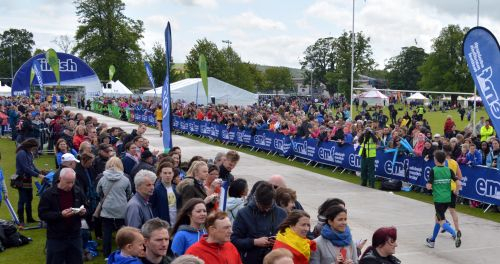
The Edinburgh Marathon Festival is not just a big day for runners. For their friends and families, it is a weekend of nervous starts, frantic journeys, enthusiastic sign-waving and emotional reunions.
With races ranging from junior events and the 5K to the half marathon, team relay and full marathon, however, spectating requires a little preparation. The headline races begin in central Edinburgh and finish in Musselburgh, while the marathon continues along the East Lothian coast before turning back. You cannot simply arrive in the city centre and expect to follow your runner by car.
Here is how to choose the best viewing locations, navigate the closures and make your support count.
Choose your viewing strategy
Before race day, decide whether you want to see your runner at the start and finish or prioritise one or two quieter points on the course.
For the marathon and half marathon, the most manageable plan is usually to watch the start in Edinburgh before using pre-booked event transport to reach the finish. Trying to make several independent stops can be stressful, especially when roads are closed and public transport is busy.
If you have young children, limited mobility or lots of bags, consider skipping the start. Head directly to Musselburgh, settle into a suitable position and give your runner one reliably loud welcome rather than risking missing them altogether.
Ask your runner for: Their race number and expected pace, their starting wave or pen, estimated arrival times at your chosen viewing points, a photograph of their race-day clothing and their preferred post-race meeting place.
Mobile tracking can help, but crowded events place heavy demand on phone networks. Treat tracking information as an estimate rather than a guarantee.
The best places to watch
The city-centre start
The marathon, half marathon and relay traditionally start around Potterrow, close to the University of Edinburgh’s McEwan Hall. Edinburgh Waverley station and Princes Street are approximately a mile away, making the area accessible on foot.
The start offers music, anticipation and the unforgettable sight of thousands of runners setting off. It is ideal for a final photograph and encouraging words, but it becomes extremely busy. Say goodbye before your runner enters the controlled start area and agree that they will not try to find you once inside.
Spectators hoping to continue to Musselburgh should leave promptly and follow their pre-arranged transport plan.
The Royal Mile and Holyrood
Early in the route, runners pass some of Edinburgh’s best-known sights, including the Old Town, Princes Street Gardens, the Royal Mile, the Scottish Parliament and Holyrood. This is the most dramatic backdrop for photographs, although central sections can be crowded.
Choose one precise landmark rather than saying, “We’ll be somewhere on the Royal Mile.” Tell your runner which side of the road you intend to use and bring a bright, distinctive sign.
Saturday’s 5K, 10K and junior races are centred around Holyrood Park and the festival hub near Dynamic Earth. These shorter events are compact and particularly family-friendly, although Arthur’s Seat and surrounding roads are affected by event restrictions. The official festival programme lists the races and current start times.
Portobello Promenade
Portobello is one of the most enjoyable marathon-viewing locations. The seaside setting has cafés, public facilities and more room than the city centre, while the long promenade gives spectators a good chance of spotting approaching runners.
It is also early enough in the marathon for runners to look relatively comfortable. That makes it a great place for photographs and personalised encouragement. Stand clear of the course, keep dogs on short leads and never step in front of runners for a picture.
Musselburgh and the finish
Both the marathon and half marathon finish in Musselburgh, traditionally on the playing fields at Pinkie St Peter’s Primary School. The final approach delivers the biggest emotional payoff: exhausted runners hear the crowd before entering the finishing area.
Arrive well ahead of your runner. Access routes become congested, and walking from transport drop-off points can take longer than expected. Do not promise to stand directly beside the finish line; prime positions fill quickly and some areas are reserved for event operations.
Prestonpans, Cockenzie and Port Seton
For marathon spectators seeking a quieter experience, the East Lothian coastal communities provide valuable support points. The route runs through Prestonpans, Cockenzie and Port Seton before continuing towards Longniddry and Gosford House and returning towards Musselburgh.
These later miles are where encouragement matters most. Crowds are thinner, fatigue is setting in and a familiar face can transform a runner’s race. The complication is transport: several roads and bus services are disrupted, so this option works best for people staying locally or those who have studied the event-day arrangements carefully. The official route description explains how the course travels through these communities.
Travel without the stress
Walking and official event buses are generally the most dependable choices. Spectator bus packages may connect selected park-and-ride sites with the start and Wallyford, near the finish, but tickets can sell out and operating details change annually.
Musselburgh and Wallyford railway stations are each roughly a mile from the finish. Rail services provide a useful connection to Edinburgh Waverley, but capacity can be extremely limited after the event. Allow time to queue and avoid booking a tightly timed return journey.
There is no general event parking at the Musselburgh finish, and surrounding restrictions are actively enforced. Wallyford Park and Ride may also be reserved for event transport rather than normal parking. Driving into the finish area risks blocked roads, fines or towing, so use only parking and transport explicitly authorised for that year’s festival. Consult the official transport page before travelling.
Understand the road closures
Closures extend far beyond the start and finish. Recent traffic plans have divided the affected route into seven broad zones covering:
Holyrood Park, Potterrow, city centre, Restalrig, Seafield, Portobello, Joppa, Musselburgh and the promenade, Pinkie, Inveresk, Wallyford, Prestonpans, Cockenzie, Port Seton, Seton Sands, Gosford and Aberlady.
Parking suspensions and bus diversions may begin before runners arrive and remain until the route has been cleaned and declared safe. Never move cones, enter a closed road or assume that a gap in the field means the road has reopened. Download the current year’s closure document shortly before race weekend and check council and transport-operator updates on the morning itself. Edinburgh City Council publishes the formal traffic restrictions.
Set a sensible meeting point
“Meet me at the finish” is not a sufficient plan. The finish area is large, noisy and full of people wearing similar medals and foil blankets.
Choose a fixed landmark outside the busiest flow of finishers, ideally one shown on the official event map. Agree on a backup location and a waiting rule—for example, “Stay there for 30 minutes even if messages do not send.” Runners should complete medal collection, baggage retrieval and any medical checks before attempting to meet family.
Pack warm, dry clothing for them if permitted, plus a familiar snack and comfortable shoes. Edinburgh’s coastal weather can change quickly, and runners cool down surprisingly fast.
Make your support count
The best encouragement is personal, positive and easy to understand. Use the runner’s name, celebrate the effort and avoid shouting inaccurate promises such as “Nearly there!” unless the finish genuinely is close.
Bring a bold sign, cowbell or clapper where permitted, but remember that runners may be overwhelmed by constant noise. Cheer for people without supporters too—especially charity runners, relay participants and anyone struggling through the later miles.
Most importantly, follow your runner’s wishes. Some want photographs and conversation; others need only a smile and a few energising words. With a realistic route plan, an unmistakable meeting point and plenty of patience, you can become part of what makes the Edinburgh Marathon Festival memorable—not simply a spectator, but an essential member of the support team.